
Understand Guitar Effects Chain Order
On a pedalboard, delay before drive sends the echoes through distortion. Drive before delay gives you progressively quieter copies of the distorted chord. BrowserTones uses a fixed effect order. You can change the amount and timing of its echo by describing the sound you want. Swapping these two stages requires a pedalboard or software with movable effects.
Start audio, then choose Apply prompt to add a 310 ms echo in the player’s fixed chain. Hear A and B.
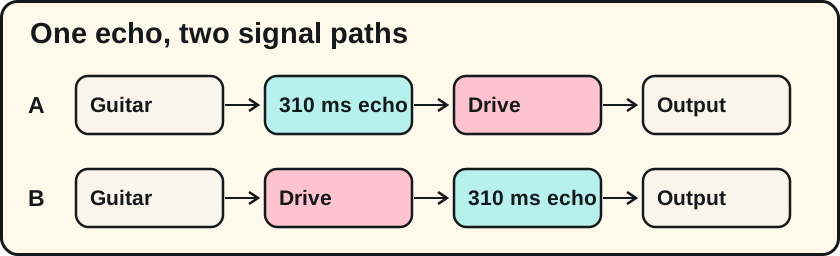
Follow one note from the guitar to the speaker
A common pedalboard runs guitar → tuner → compressor or wah → drive → modulation → delay → reverb. With a clean amp, plugging this chain into the input gives a convenient starting point. If most distortion comes from the amp preamp, an effects loop lets you put delay and reverb after that distortion. Check the amp’s loop instructions and signal levels before connecting pedals.
Hear delay before and after drive
Listen past the first short chord. In A, even the second repeat has a hard, gritty edge. In B, the pick stroke stays strong and the echoes step down quickly. The gaps in the guitar part give you room to hear them.
We made this pedalboard comparison in an audio editor. We used one guitar recording, one 310 ms delay and the same soft-clipping drive, then switched their order. The first pick stroke is matched between the two versions. In this example the second repeat is about 16 dB louder with delay before drive.
Read the echoes in the recording
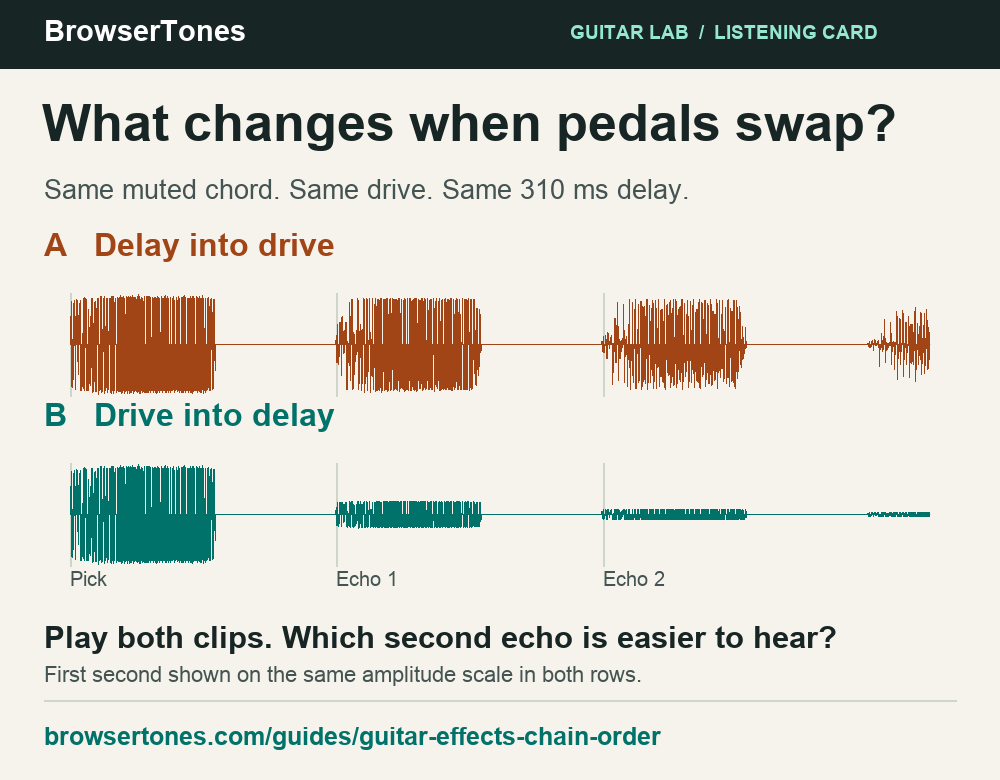
For a listening lesson, cover the rows, play both clips and ask which second echo is louder. Reveal the card and compare. This example uses a movable pedal chain in an audio editor. BrowserTones keeps its own effects in a fixed order.
You’re welcome to share the listening card (PNG) in a lesson or article. Suggested source: BrowserTones’ pedal-order listening test.
Where the effects sit in BrowserTones
BrowserTones routes the amp into cabinet processing and places its main delay and reverb after the cabinet. To hear a change you can make in the player, apply Crunch rhythm, an audible 310 ms echo, low feedback, no reverb.
Mute the strings after one chord. Then ask Keep the crunch and switch delay off.
The repeat should disappear. The routing stays fixed.
Pick the order that solves the musical problem
If you have a drive pedal and a delay, set the delay for one audible repeat. Play a chord and stop the strings before the repeat arrives. With drive first, the echo copies the chord’s distorted edge. Swap the pedals and listen to the fading repeat again. Then play a second chord over the first echo. The overlap is often where the two orders sound furthest apart.
To choose an order for your own pedalboard, play two chords a beat apart and mute both. If the second chord disappears into the first echo, try drive before delay and lower the feedback. If you want the overlap to swell into distortion, try delay before drive and let the first chord ring. Compare clean and crunch on the same guitar part or try a focused effect request.
By BrowserTones · Updated